Staggering Beauty: The Chaos of Motion
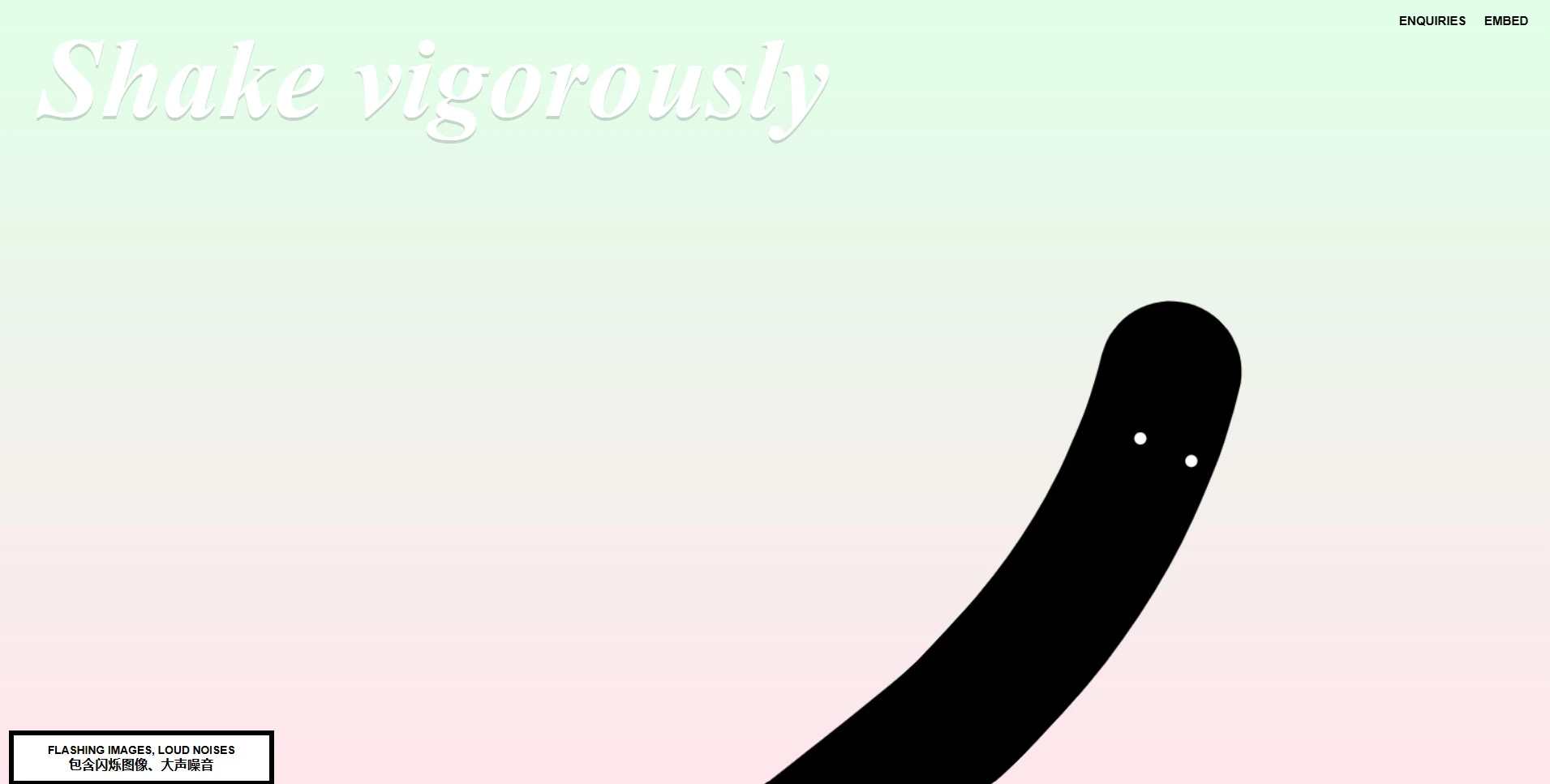
Staggering Beauty is a seminal work in the "Single-Purpose Web" movement. At its core, the experience presents a singular, fluid, worm-like entity constructed from a series of concatenated nodes. While the initial interaction suggests a docile, physics-based follow-bot, the underlying script is programmed to detect high-velocity displacement of the mouse cursor.
The Kinetic Threshold
The technical brilliance of the site lies in its use of Vector Magnitude Analysis. The browser continuously calculates the distance between the current cursor coordinate $$(x_2, y_2)$$ and the previous coordinate $$(x_1, y_1)$$. Once the velocity $$(\Delta d / \Delta t)$$ crosses a hard-coded "excitement" threshold, the DOM undergoes a violent state-change. This transition is not merely a CSS filter; it is an orchestrated sensory overload that utilizes rapid frame-buffer clearing and randomized hex-code background cycling.
- Recursive Node-Trailing: The entity utilizes a spring-physics algorithm where each subsequent node $$(n+1)$$ attempts to reach the position of the parent node $$(n)$$ with a slight dampening delay.
- Dynamic Rendering: The strobe effect is achieved by bypassing standard transition easing, forcing the browser to render high-contrast primary colors at the maximum refresh rate (Hz) available to the display.
- Input Detection: By leveraging the
requestAnimationFrameAPI, the site ensures the visual assault is perfectly synced with the hardware's capabilities, making the experience feel uniquely visceral on every device.
Biological Response & Digital Provocation
In the PagesChaos archive, Staggering Beauty is categorized as a Digital Sensory Trap. It exploits the human instinct to "shake" or "move" something that feels sluggish. By providing a creature that feels heavy and elastic, the site subtly goads the user into moving their mouse more vigorously. This creates a psychological loop where the user's own curiosity becomes the trigger for their sensory discomfort.
Legacy of the "Useless" Web
Similar to Koalas to the Max (which uses recursive circle-packing), Staggering Beauty takes a complex mathematical concept—in this case, Inverse Kinematics—and hides it behind a facade of absurdity. It stands as a pinnacle of the 2010s "Flash-adjacent" era, proving that a single line of physics logic can create an unforgettable, albeit jarring, digital memory. It is a reminder that the web is not just a place for information, but a canvas for experiments that can physically affect the viewer.