The Hidden Layers of Koala to the Max
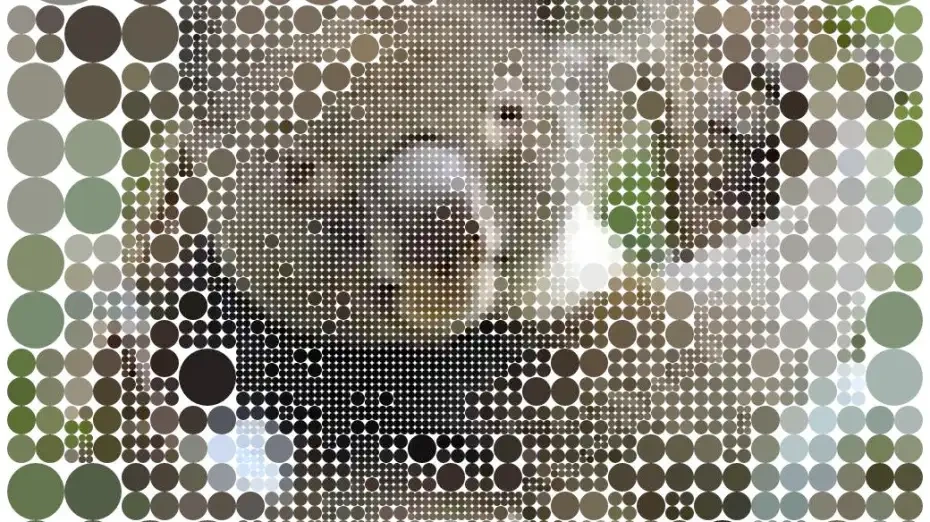
At first contact, the interface presents an almost aggressive minimalism: a single, monochromatic circle suspended in a light-gray digital vacuum. Yet, beneath this deceptive simplicity lies one of the most hypnotic interaction experiments in the history of the modern web. As the cursor glides across the viewport, the user ceases to be a mere visitor and evolves into an active agent of fragmentation. Each movement triggers a geometric cascade where unity is traded for complexity, and silence is replaced by the visual noise of thousands of emerging nodes.
Koala to the Max is far more than a simple game of visual dexterity or a digital toy; it is a meticulously choreographed ballet of pixels that challenges our fundamental perceptions of patience, curiosity, and resolution. It serves as a perfect representation of how information, when meticulously decomposed into its most infinitesimal components, reveals hidden truths that the human eye cannot perceive from a macroscopic viewpoint. In the universe of PagesChaos, this entry stands as a testament to the beauty of granular discovery.
The Architecture of Chaos: The Quadtree Logic
The technical sorcery powering this experience does not rely on basic image masking or standard CSS transitions. Instead, it utilizes a sophisticated spatial data structure known in computer science as a Quadtree. This algorithm is a cornerstone of modern image processing, collision detection, and geographic information systems. The logic is elegant: every time the user’s cursor intersects the boundary of a circle, the system executes a recursive subdivision instruction, partitioning the "parent node" into exactly four "child nodes" of equal area.
This process is far from arbitrary. Each circle, regardless of its size during the subdivision process, inherits a specific color property. This color is calculated by sampling the source image hidden within the canvas background. While the circles remain large, the image appears as an impressionistic blur—a digital ghost of the data it represents. As the user insists on further fragmentation, the colors become precise, the forms sharpen, and the identity of the subject—the titular koala—emerges from the cold, mathematical abstraction of the grid.
SYSTEM_ANALYSIS // DEEP_DIVE:
- Recursive Subtraction: Each mouse-over event serves as a logical trigger that segments the two-dimensional coordinate space until it reaches the physical resolution limit of the browser's DOM.
- Dynamic Chromatic Mappings: The engine calculates the average hexadecimal value of the hidden pixel cluster to assign a specific tone to every newly generated circular node in real-time.
- Resource Optimization: Despite the generation of thousands of individual SVG or Div elements, the tree-based hierarchy allows the browser to manage memory overhead effectively, preventing "jank" during rapid interaction.
- Convergence Point: The subdivision process terminates automatically when a circle’s diameter reaches a threshold (usually 2 pixels), where digital representation and the underlying source material become indistinguishable.
Philosophy of Digital Persistence
Within the PagesChaos archive, we categorize this site as a fundamental piece of Digital Anthropology. It poses a profound question to the modern netizen: Why do we invest minutes of our finite lifespans manually revealing an image that could be retrieved in a fraction of a second via a standard search engine? The answer lies in the intrinsic human gratification found in the act of revelation. There is a primal pleasure in the manual effort required to clear away the digital fog in order to find the signal within the noise.
This experience teaches us that any complex system, no matter how imposing or incomprehensible it may initially seem, can be fully understood if we are willing to break it down into manageable, bite-sized components. It serves as a metaphor for existence in the information age: sometimes, to truly comprehend the "Big Picture," we must first become obsessed with the smallest, most granular details. Granularity is not just a technical measurement of resolution; it is a way of interpreting reality through the lens of data and interaction.
As the segmentation concludes, the user has not only revealed a photo; they have participated in the reconstruction of reality. You have manipulated variables, constants, and geometry to give form to chaos. It is a stark reminder that in an era defined by instant results, the painstaking process of "loading" can be just as valuable—if not more so—than the destination itself. The koala is your reward, but the journey through the pixels is the true archive entry.