Global Paper Planes: Digital Catch-and-Release
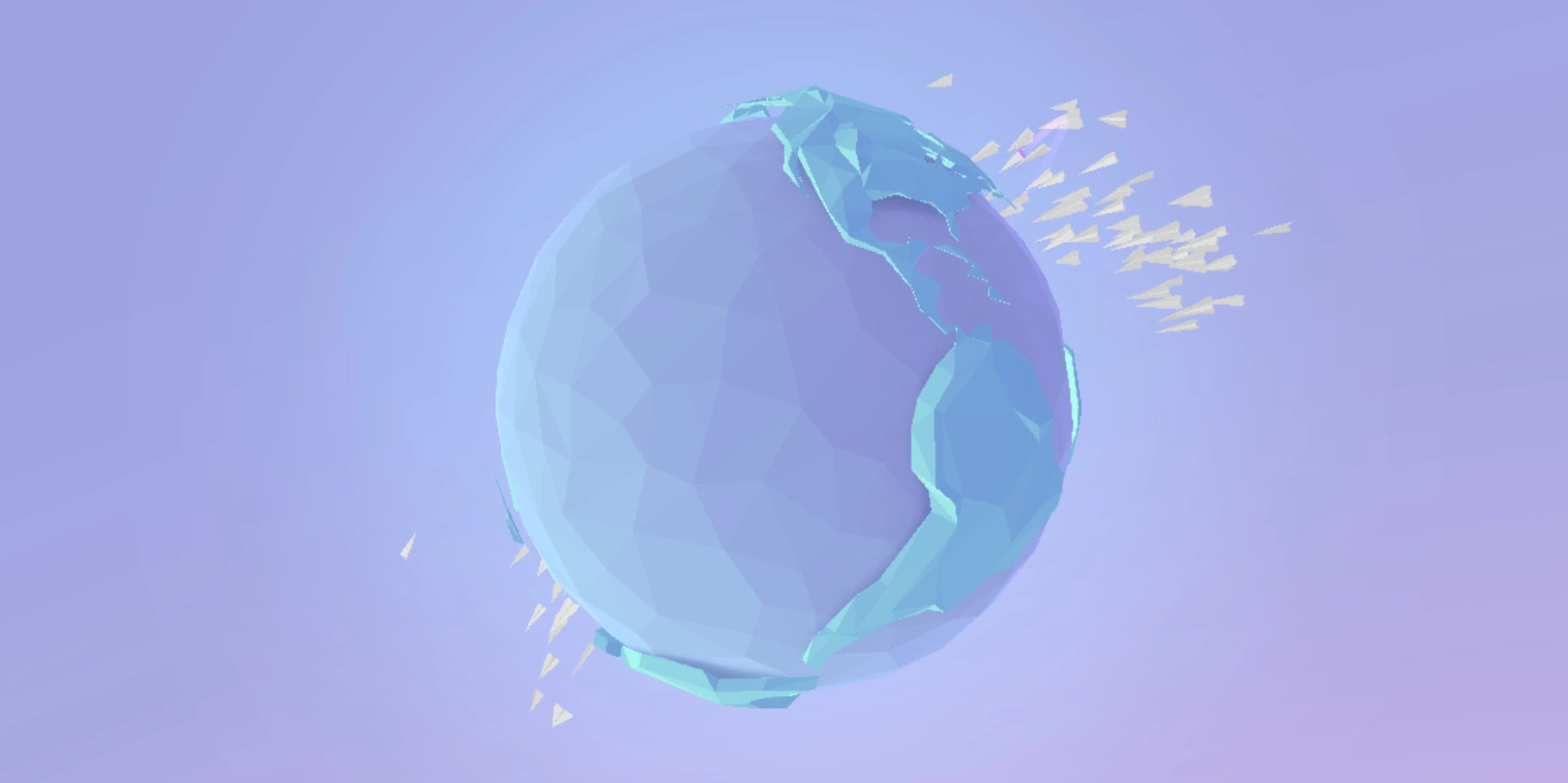
Paper Planes originated as an ambitious experiment for Google I/O, designed to demonstrate the fluid potential of multi-device synchronization and modern web connectivity. It creates a seamless bridge between a user's mobile handheld and a shared desktop visualization, allowing individuals to "throw" a personalized digital plane into a collective, global sky.
Multi-Screen Synchronization & Motion Capture
The technical elegance of Paper Planes lies in its handling of low-latency data streams. The experience utilizes a "Dual-Interface" model: your mobile device acts as the kinetic input (the launcher), while the desktop functions as the macroscopic observer (the world). This interaction is governed by the WebSockets (WSS) protocol, allowing for full-duplex communication channels that bypass the overhead of traditional HTTP requests.
VECTOR_CALC: $V = \sqrt{a_x^2 + a_y^2 + a_z^2}$
TRANSMISSION_DELAY: < 50ms
- Sensor Fusion & Gesture Recognition: The mobile client leverages the
DeviceOrientationEventandDeviceMotionEventAPIs. By calculating the peak acceleration during a throwing gesture, the system determines the initial velocity and arc of the virtual plane. - Global Real-time State: Every "thrown" plane is assigned a unique ID and a timestamped geospatial coordinate. This data is broadcast via a central server to every active desktop client, where it is rendered as a 3D object moving through a coordinate-mapped WebGL environment.
- Stamp & Capture Mechanic: When a user "catches" a plane by performing a swiping motion on their mobile device, the server updates the plane's history. Each plane becomes a living document, carrying a visual log of every city it has visited.
- Instanced Rendering: To display thousands of planes simultaneously without overwhelming the client's GPU, the system uses "Geometry Instancing" in WebGL, allowing it to render many copies of the same mesh with different transformation matrices in a single draw call.
Human Interconnection
In the PagesChaos archive, Global Paper Planes serves as the ultimate example of the Invisible Network. It transcends mere data visualization by adding a layer of emotional resonance to network packets. Every plane is a literal representation of a human "touch," caught and released across borders. It reminds us that every digital interaction is a message launched into a vast void, validated only when caught by a participant on the other side of the planet.
Archival Significance
As a piece of web history, Paper Planes marked the moment the "Mobile Web" ceased to be a separate entity from the "Desktop Web." It proved that the browser could handle complex physics, 3D environments, and real-time networking in a unified experience. It remains a benchmark for Phygital Design—the merging of physical movement with digital output.