The Coordinate Database of Pointer Pointer
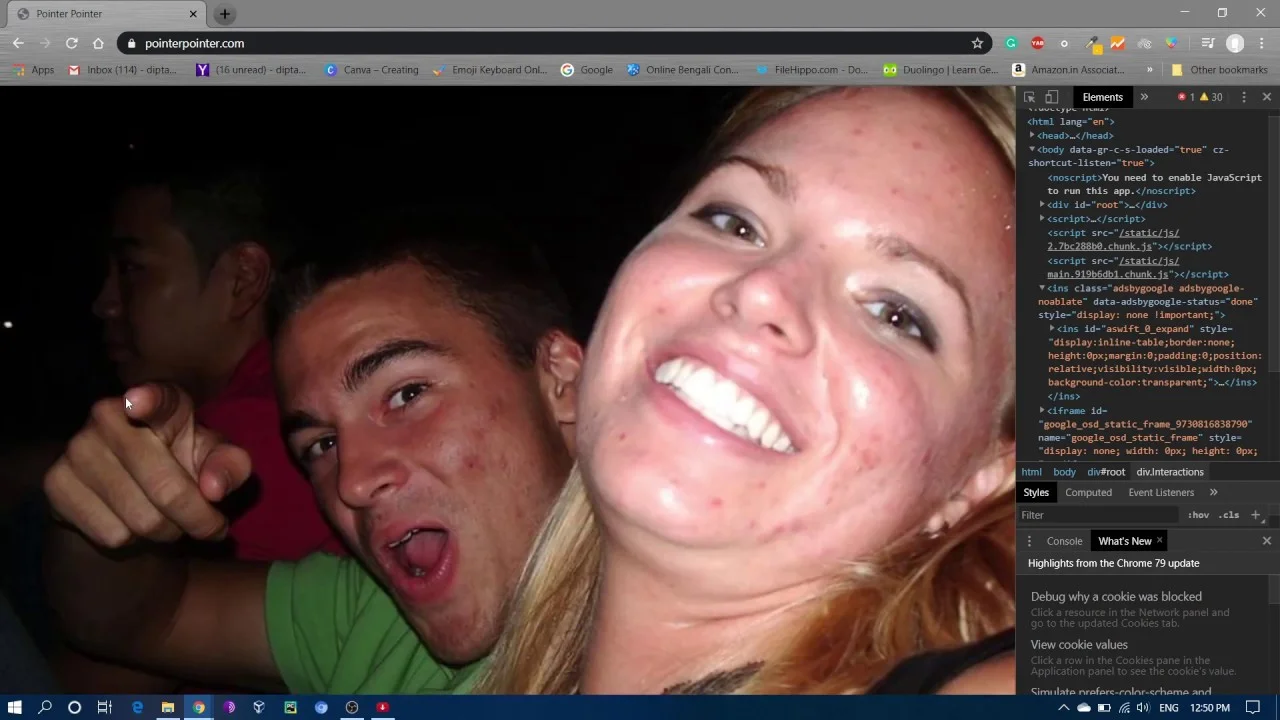
What happens when you combine thousands of static, seemingly unrelated photographs with a precise tracking script? You get Pointer Pointer, a digital experiment by Studio Moniker (Roel Wouters) that feels unsettlingly telepathic. It is an artifact of "Brute-Force Information Architecture," where sheer volume creates the illusion of sentient observation.
The Illusion of Awareness
The site's premise is deceptively simple: place your cursor anywhere on the screen, and after a moment of "calculation," the system presents a low-resolution photo of a person pointing directly at that exact location. While it feels like Artificial Intelligence, the technical reality is a masterpiece of Manual Metadata Tagging and 2D spatial sectoring.
Meticulous Data Mapping
To achieve this effect, the developers had to solve a complex retrieval problem. The screen is divided into a high-resolution grid. Each image in the database has been pre-analyzed to identify the precise pixel coordinate $(x_i, y_i)$ where the fingertip ends and the direction vector $\vec{v}$ of the point.
- Cartesian Sectoring: The viewport is mapped into a normalized coordinate system from $0.0$ to $1.0$. When the user stops moving their mouse, the script identifies the specific sector occupied by the cursor.
- The "Closest Neighbor" Search: The engine performs a search through its internal JSON manifest. It looks for the image whose "pointing target" coordinate has the smallest Euclidean distance to the user's cursor: $$d = \sqrt{(x_c - x_i)^2 + (y_c - y_i)^2}$$
- Temporal Friction: The site intentionally includes a "Searching..." loader. This isn't due to slow processing—it is a psychological buffer designed to increase the "payoff" when the image finally appears, making the result feel more earned and targeted.
The Human Side of Data
Within the PagesChaos archive, Pointer Pointer represents the Aesthetic of the Mundane. The images used are not professional stock photos; they are grainy, amateur party pictures and casual snapshots. By organizing these "forgotten" moments into a functional grid, Studio Moniker creates a bridge between cold, digital coordinates and warm, human gestures. It proves that with enough data, even the most chaotic set of human snapshots can be turned into a perfectly ordered system.
Archival Note on UX
Pointer Pointer remains a gold standard in UX design because it creates an immediate Feedback Loop. There is no learning curve; the user’s natural behavior (moving the mouse) is the only input required. It is a reminder that the most profound digital experiences often come from the simplest interactions, provided they are backed by an immense, hidden architecture.