Silk: The Analysis of Generative Flow
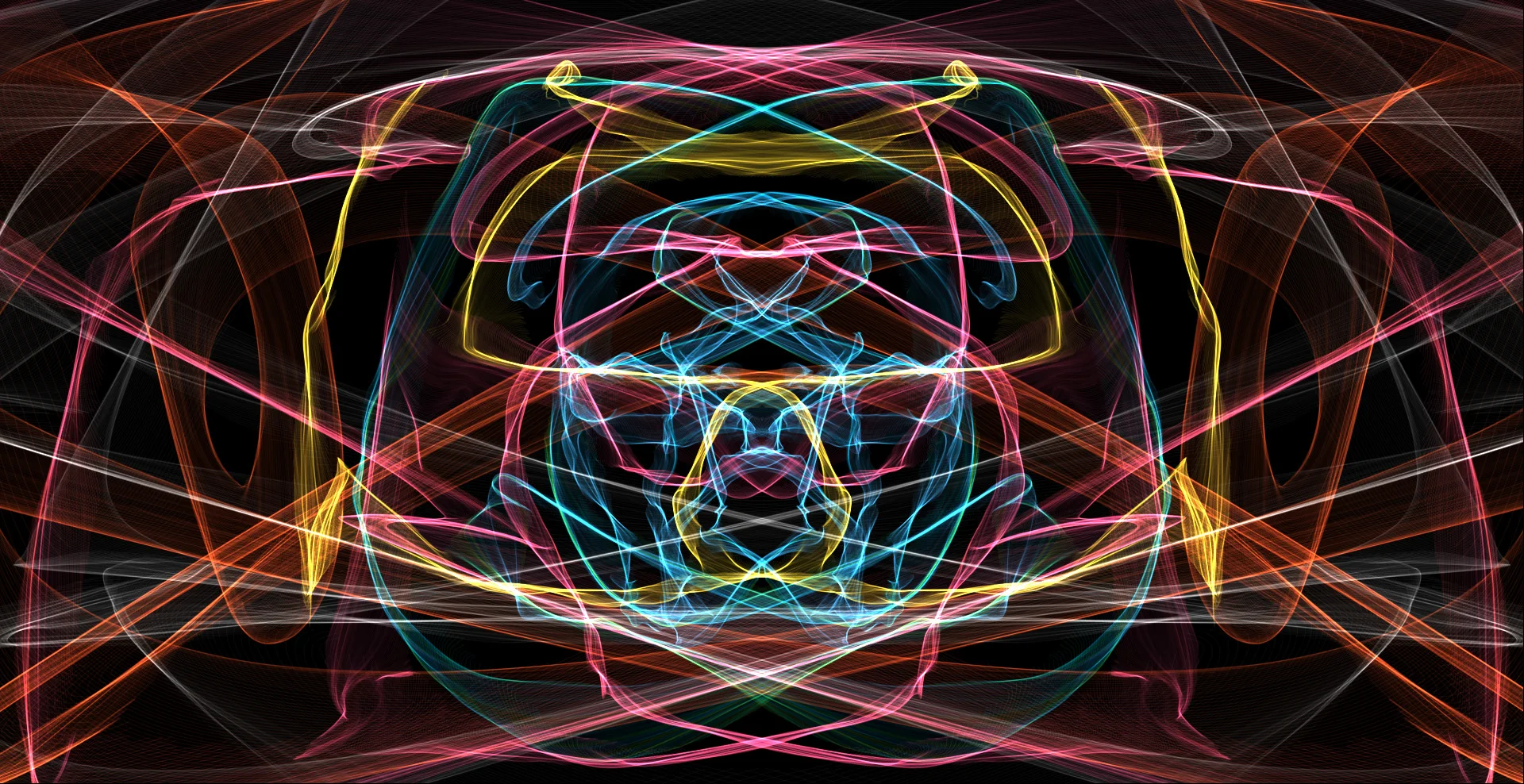
Silk is an iconic interactive experiment in generative art, originally developed by Yuri Vishnevsky. It transforms the act of clicking into a rhythmic flow of luminous, silk-like strands. The project serves as a masterclass in how rigid mathematical constraints can be tuned to produce organic, "living" beauty that bridges the gap between digital simulation and human intuition.
The Geometry of Rotational Flow
The core of the Silk engine is its multi-axis rotational symmetry. Every mouse movement—a single input vector—is processed through a series of transformations that mirror and rotate the path across a central origin. This allows even the most chaotic user input to emerge as a highly structured, kaleidoscopic form resembling nebulas, deep-sea organisms, or intricate fractal silk.
Iterated over $n$ points of symmetry to distribute the generative stroke.
- Bézier Curve Interpolation: To ensure the "flow" feels fluid and frictionless, the system does not simply draw lines between points. It uses quadratic Bézier curves to smooth raw mouse input, creating the signature undulating aesthetic of the strands.
- Additive Light Blending: Silk utilizes an additive blending model (similar to "Screen" or "Linear Dodge" in digital painting). When multiple strands overlap, their color values are summed, resulting in "hot spots" of intense glow that mimic the behavior of light passing through silk or gas.
- Adaptive Particle Trails: Each strand is composed of thousands of micro-particles that follow a lead vector. The "hairiness" of the strands is controlled by a noise algorithm that adds slight variations to the particle paths, preventing the art from looking mathematically "stiff."
- Dynamic Color Gradients: The palette engine rotates through a HSL (Hue, Saturation, Lightness) space, ensuring that as you weave, the colors maintain a harmonic relationship even as they shift across the spectrum.
The Democratization of Creation
In the PagesChaos archive, Silk is recognized for its role in Generative Democratization. It effectively removes the "barrier of skill" from artistic creation. By providing the user with a pre-configured algorithmic framework, it allows anyone to participate in the emergence of complex digital structures. It isn't a tool for drawing so much as it is a tool for *discovery*.
Archival Note: The Aesthetic of Emergence
Silk is a reminder that beauty in the digital age often arises from the tension between user freedom and algorithmic order. It does not dictate what the user creates, but it ensures that whatever is created follows the universal laws of symmetry and light. It remains a definitive example of "Software as an Instrument," where the developer builds the violin, and the user provides the music.