Real Time Web Stats: The Pulse of Chaos
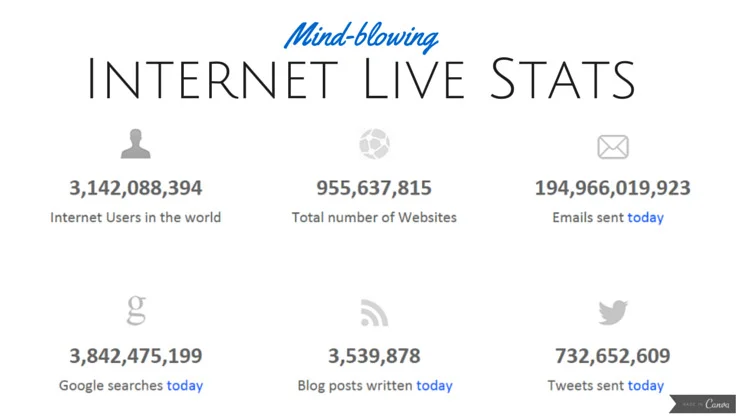
Real Time Web Stats (specifically platforms like Internet Live Stats) provides a staggering, almost visceral look into the sheer volume of human activity occurring online every second. It serves as a digital speedometer for the planet, translating the abstract concept of "The Internet" into a frenetic, ever-growing numerical tally of emails, searches, and social interactions.
The Mathematics of Estimation
A common misconception is that these sites are connected to a "global master server" receiving live pings for every email sent. In reality, the technical feat is one of Statistical Extrapolation and Time-Series Modeling. The system uses a velocity algorithm to estimate the current count based on verified data points from global organizations like the ITU and the World Bank.
[Image of linear extrapolation graph]Where $C$ is the count, $R$ is the calculated growth rate, and $\Delta t$ is elapsed time in milliseconds.
- Velocity Algorithm Tuning: The counters do not move at a perfectly linear pace. To maintain "High Fidelity Realism," the algorithms introduce a Poisson distribution model, which adds slight, random fluctuations to the rate of increase, mimicking the natural, non-linear burstiness of human traffic.
- JavaScript Clock Precision: Because standard
setTimeoutis subject to drift, the engine utilizes therequestAnimationFrameAPI. This ensures the UI updates are synchronized with the display's refresh rate (typically 60Hz), making the number climb look perfectly smooth to the human eye. - Millisecond Accuracy: By using the
Performance.now()API, the site can calculate elapsed time since the page load with sub-millisecond precision, preventing "lag-jumps" if the browser's main thread becomes momentarily congested. - Periodic Syncing: While the counters run locally on your browser, they periodically "heartbeat" with the server-side database to adjust the $R_{avg}$ based on the most recent quarterly reports, ensuring the local simulation never drifts too far from historical reality.
Information Overload as Art
In the PagesChaos archive, these stats are categorized under Digital Velocity. Beyond the numbers, the site acts as a memento mori for the information age. It visualizes the "Information Explosion," reminding the viewer that while they spend three minutes reading this archive entry, nearly 450 million emails have been sent and 1.5 million gigabytes of data have moved through the global infrastructure.
Archival Significance
Real Time Web Stats represents the transition from the "Static Web" (where data was looked up) to the "Streaming Web" (where data is felt). It is a tool designed to trigger Data-Driven Awe. By making the invisible visible, it forces us to confront the terrifying scale of our own collective digital footprint.