The Infinite Loop of Zoomquilt
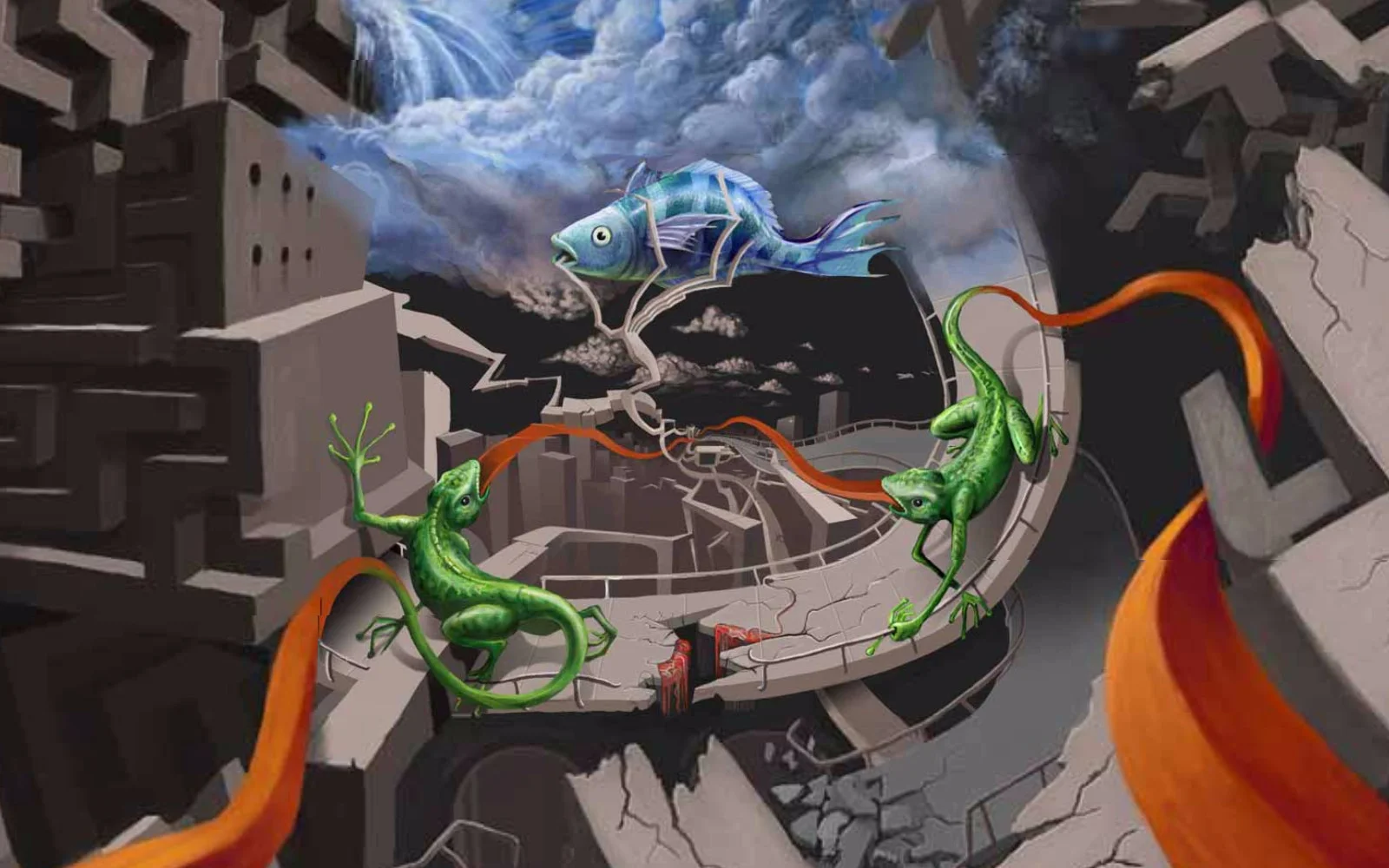
If the internet has a visual representation of the "rabbit hole," it is undoubtedly Zoomquilt. Originally launched in 2004 as a collaborative effort by Nikolaus Baumgarten and a team of illustrators, this project has evolved through several iterations, remaining the definitive digital example of seamless, infinite continuity.
The Droste Effect: Infinite Self-Reference
Technically, Zoomquilt operates on a variation of the Droste Effect, a recursive visual pattern where a smaller version of an image appears within itself. However, Zoomquilt expands this concept into a narrative. Instead of a single repeating loop, it utilizes a massive sequence of surrealist paintings where the "center" of one painting is the "frame" for the next, creating a deep, multi-layered odyssey through alien forests, biological architectures, and celestial voids.
Mathematical model for the constant exponential scaling of the focal canvas.
- Recursive Viewport Scaling: The engine renders multiple layers of high-resolution images simultaneously. As the foreground layer expands and disappears past the viewport boundaries, the next layer is already scaled and positioned at the central coordinates $(0, 0)$, creating the illusion of constant forward motion.
- The Collaborative Grid: The project's brilliance lies in its strict spatial constraints. Each participating artist was assigned a "panel" but had to ensure that their inner focal point perfectly matched the outer edges of the next artist's work. This required a level of pixel-perfect coordination rarely seen in mid-2000s net art.
- Perceptual Persistence & Alpha Blending: To prevent "pop-in" or jarring transitions, the engine uses subtle alpha-blending at the borders of each recursive layer. This ensures that the viewer's eye remains locked on the center, inducing a state of low-level hypnosis known as the "Waterfall Effect" (Motion Aftereffect).
- Resolution Management: Because an infinite zoom would eventually hit the "pixel floor," the system constantly swaps out low-resolution placeholders for high-fidelity assets as they approach the viewer, managing memory usage while maintaining visual crispness.
Breaking the Loop
In the PagesChaos archive, Zoomquilt stands as a monument to Digital Stillness. While the modern web is designed to fragment attention through notifications and rapid-fire feeds, Zoomquilt demands a singular, unfocused gaze. It is a digital Zen garden where the user is absolved of the need to click, scroll, or choose. There is no "end," and therefore, no urgency.
Archival Note: The Legacy of Scale
Zoomquilt reminds us that digital art can be more than a static file; it can be an environment. In the 2026 landscape of generated AI imagery, the deliberate, human-painted coordination of Zoomquilt’s layers represents a high-water mark for collaborative creativity. It proves that the journey is not just the reward—it is the only thing that actually exists.